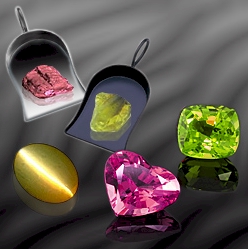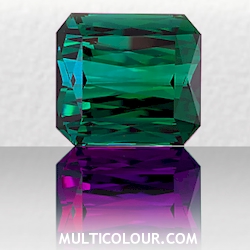
Supply and demand affects gemstone prices more than any other factor. Alexandrite is so expensive because it so rare and production has always been limited. Its historical association with the last of the Russian Tsars has created interest and allure. Everybody with an interest in gems seems to know something about alexandrite´s unique history and the story has added to the stone´s mystique. With a hardness of 8.5, alexandrite is an ideal gemstone, not only rare and beautiful but also hard and tough so it can be used in any kind of jewelry.
Supply and demand affects gemstone prices more than any other factor. Alexandrite is so expensive because it so rare and production has always been limited. Its historical association with the last of the Russian Tsars has created interest and allure. Everybody with an interest in gems seems to know something about alexandrite's unique history and the story has added to the stone's mystique. With a hardness of 8.5, alexandrite is an ideal gemstone, not only rare and beautiful but also hard and tough so it can be used in any kind of jewelry.
Chrysoberyl is the species name and alexandrite is the variety name. Alexandrite is that variety of chrysoberyl that changes color as a function of the light source; green in daylight and red under incandescent light.
Cat's eye is the popular name for an optical effect known as chatoyancy in the gemological nomenclature. Microscopic needle-like inclusions inside the stone reflect a streak of light which opens and closes as the stone is rotated -- hence the eye like effect. The effect becomes most apparent under a spotlight or in direct sunlight. Although other minerals including tourmaline, beryl, scapolite and quartz may also display the cat's eye effect, these stones are referred to as tourmaline cat's eyes or quartz cat's eyes etc., and only chrysoberyl is referred to as "cat's eye" with no other designation. Alexandrite is that variety of Chrysoberyl that can display a color change. If a chrysoberyl cat's eye also displays a color change, it is known as an Alexandrite Cat's eye.
Yes, several other well known gemstones, including sapphire, garnet, and spinel may also change color as a function of the prevailing light. Color change garnets can show an excellent color change and can easily be confused with alexandrite.
It has been determined that the absorption spectrum of all alexandrite-like minerals is characterised by transmission maxima in the blue-green and red regions and by a transmission minimum in the yellow region. The color of minerals with two such regions of transmission is determined in daylight (richer in blue and green) by the position of the transmission maxima and in incandescent light (richer in red) by the ratio of transmission in the red and transmission in the blue-violet sections of the visible spectrum.
Tanzanian stones from Tunduru occur in a wide range of colors. Many of the stones appear to be a khaki or yellowish green in daylight moving to a brownish red under incandescent light. The deposit also produces some world class bluish green to purple red stones. Brazilian alexandrites are generally bluish green to blue/green in daylight and reddish purple-to-purple red under incandescent light. Indian stones are well known for their outstanding daylight bluish green colors and superior clarity. Under incandescent light they appear plumb reddish purple.
Microscopic needle-like inclusions inside the stone reflect a streak of light known as a cat's eye. The cat's eye's inclusions are aligned parallel to the crystallographic axis and they are always cut as cabochons with the fibrous need-like inclusions running across the narrow part of the stone as this is the best way to display the effect properly.
The retail replacement cost for a 1ct. alexandrite could be anywhere between USD 150 to USD 10,000 per ct. The intensity of the color change and the attractiveness of the colors is the most important factor in determining the value of an alexandrite. The cut, clarity, and weight are also critical factors.
In 1 ct. sizes, top quality alexandrites are among the most expensive gemstones in the world surpassing even rubies and emeralds. In larger sizes over 3 or 4cts., top Burmese rubies may be even more expensive than alexandrite. Although top alexandrites are much more rare than fine diamonds, wholesale prices for top diamonds are typically somewhat higher than fine alexandrites.
Natural alexandrite is not better than synthetic alexandrite but it is much more rare. There are several manufacturers of synthetic alexandrite and production of large and clean stones does not seem to be limited by any factors other than capital investment in the growing operation. For more information please refer to alexandrite buyer guide chapter.
Alexandrite is generally not treated at all and it cannot be improved by heating. Occasionally, low quality cracked stones are oiled to hide inclusions but most stones are not treated in any way. Chrysoberyl cat's eyes are sometimes irradiated to produce a brownish color that some customers prefer.
Natural alexandrites are available in a complete range of colors from brownish to bluish green in daylight to pink, purple, red or brownish red under incandescent light. Compared to natural stones, most synthetic alexandrites are somewhat more blue under fluorescent light and strongly red under incandescent light. Large clean and inexpensive stones offered as natural alexandrites are most probably synthetic or not alexandrite at all. Gemologists study the inclusions to distinguish between natural and synthetic alexandrite. Synthetic stones may also have a lower refractive index and show more fluorescence than natural stones. Natural alexandrites should be purchased from reputable dealers and expensive stones should also be tested and certified by a well established gem lab. For more information please refer to alexandrite synthetics and imitations chapter.
We receive many inquiries about old and inherited alexandrites. Unfortunately, synthetic alexandrite like sapphire has been around for almost 100 years and that´s what most of these inquiries turn out to be. Natural alexandrites, especially large and clean stones are extremely rare. Questionable stones should be tested by qualified and experienced gemologists. For more information please refer to alexandrite synthetics and imitations chapter.
People always talk about the quality of the Russian stones but there is no current production of stones from Russia. Overall the best alexandrites are probably from Brazil but exceptional stones are can also found in India, Tanzania, and Madagascar. For more information please refer to alexandrite world occurrences.
With a hardness of 8.5, Alexandrite is a tough, hard, and durable gemstone that doesn't require any special care. Alexandrite jewelry can be cleaned in an ultrasonic bath or steam cleaned without any problems.