PDA Text only High contrast
Skip to main content
 

Chrysoberyl Classification and Properties

"Crude classifications and false generalizations are the curse of organized life." George Bernard Shaw
Alexandrite gemstone buyer and collectors guide

Chrysoberyl is the third hardest naturally occurring gemstone and lies between corundum and topaz on the hardness scale. Only corundum and diamond are harder and chrysoberyl is well known for its toughness and durability. Rubbing chrysoberyl will produce a static charge that is retained for several hours. Chrysoberyl is a mineral consisting of ordinary colorless or yellow transparent chrysoberyl, cymophane (chrysoberyl cat´s eye), and alexandrite.

Ordinary chrysoberyl is a yellowish-green, transparent to translucent chrysoberyl. Ordinary chrysoberyl has often been referred to in the literature as chrysolite due to the common olive color of many of its gems, but that name is no longer used in the gemological nomenclature. When the mineral exhibits good pale green to yellow color and is transparent, then it is used as a gemstone.

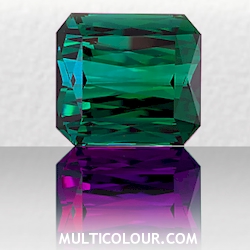
Alexandrite, a strongly pleochroic (dichroic) gem, will exhibit emerald green, red and orange-yellow colors and tend to change color in artificial light compared to daylight. The color change from red to green is due to strong absorption of light in the yellow and blue portions of the spectrum. Typically, alexandrite has an emerald green color in daylight but exhibit a raspberry red color in incandescent light.

Cymophane is popularly known as cat´s eye. This variety exhibits pleasing chatoyancy or opalescence that reminds one of an eye of a cat. When cut to produce a cabochon, the mineral forms a light-green specimen with a silky band of light extending across the surface of the stone.

Properties datasheet

Chrysoberyl is often found as twins that produce wedge-shaped or heart-shaped crystals with v-striations. It is also found in pseudohexagonal crystals with repeated twining resulting in sixlings and less commonly as contact twins that are extended along the c-axis (c[001]). Also found as granular to massive material.

SynonymsAlumoberyl, Chrysberil, Chrysoberil, Chrysopal, Delamétherie, Crisoberilo, Krysoberril, Oriental Chrysolite Pacific Cat´s Eye, Cat´s eye, cat eye.
VarietiesAlexandrite, Cymophane
IMA statusValid Species (Pre-IMA)
Identifying characteristicsFingerprint inclusions, silk, color change
Absorption spectraTwo strong lines at 680.5 and 678.5 nm and weak lines at 665, 655, and 645 nm, partial absorption between 580 and 630, three weak lines at 476.5, 473, and 468 nm, and general absorption in the violet.
BirefringenceWeak (0.008-0.011)
Chemical compositionCr3+: BeAl2O4
ClassOxides
CleavageDistinct on {011} perfect, indistinct on {010}, and poor on {100}
ColorGreen in daylight and red-violet in incandescent light.
Crystal habitPrismatic crystals are elongated on c, and often tabular on {001}, with striations parallel to [100]
Crystal systemOrthorhombic. 2/m2/m2/m
DensityG/cm3 3,79
Dispersion.015
Hardness8.5
Heat sensitiveNo
Lattice constantsA a=5.47, b=9.39, c=4.42
LustreVitreous to greasy
Melting point1870 C
Molecular weight126.97 gm
Beryllium 7.10 % Be 19.70 %
BeO
Aluminum 42.50 % Al
80.30 % Al2O3
Oxygen 50.40 % O
Optic characterDR, biaxial positive
Optical effectsMetamerism, pleochroism
PleochroismStrong, X= red-purple, Y= orange, Z= green
Refractive index1.745 - 1.759 (+ .004, - .006)
Specific Gravity3.70 to 3.78
StabilityHeat tolerance: Stable
Light tolerance: Stable
Chemical tolerance: None
StreakWhite
ToughnessExcellent
TransparencyTransparent to translucent
TwinningCommonly twinned on {130} resulting in a triangular or kite shaped form, repeated cyclic twinning produces pseudo hexagonal trillings.
Ultraviolet fluorescenceInert to moderate red (LW and SW)

The mineral chrysoberyl is very rare but periodically found as an accessory mineral in granite pegmatites, aplites and mica schists. It is also described in altered zones around the margins of ultramafic rocks where they have been intruded by Be-rich granite pegmatites. Because of its favorable hardness and relatively high specific gravity it may also be found as a placer mineral downstream from these hosts. Chrysoberyl has high enough specific gravity that it will concentrate with black sands in active or paleoplacer stream deposits and concentrate with other relatively heavy minerals such as cassiterite, diamond, corundum, topaz and garnet. When found in placers, it will have rounded edges instead of sharp, wedge-shape forms. Much of the chrysoberyl mined in Brazil and Sri Lanka is recovered from placers as the host rocks have been intensely weathered and eroded.

Chrysoberyl deposits can be divided into three types, excluding rare dolomitic hosts. These include chrysoberyl in pegmatites intruded into ultramafic rocks, chrysoberyl hosted by pegmatites intruded into aluminous rocks, and chrysoberyl found as a primary mineral in REE-pegmatites.

There have been very few research projects on the genesis of chrysoberyl due to its rarity in primary host rocks since most chrysoberyl is recovered from placers. However, it may be hypothesized that in order to produce chrysoberyl, metamorphic overprint of some beryllium- and aluminum-rich pegmatites may be necessary.

References

  • Cornelius S. Hurlbut and Robert C. Kammerling. Gemology. Wiley-Interscience. 1991.
  • Dan Hausel. W. Gemstones of the world geology, occurrence and exploration. Wyoming State Geological Survey, Laramie. Wyoming. 2005
  • Korbel P. Novak M. The Complete Encyclopedia of Minerals. Chartwell Books, Inc. New Jersey.1999.
  • Tweney C. F, (Ed) Chambers´s Technical Dictionary. New York. Macmillan. 1958.
  • The Columbia Encyclopedia. Columbia University Press. Sixth Edition, 2004.
 
Search
This page options
Relevant pages
Alexandrite guide
 
 
Sponsored by Multicolour Gems Ltd Design and maintenance by Netcomposite