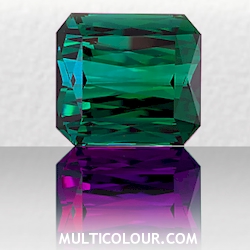
"The term alexandrite effect refers to the apparent change of color in certain minerals from blue-green or greenish violet in daylight to red or reddish violet in incandescent light. It has been determined that the absorption spectrum of all alexandrite-like minerals is characterised by transmission maxima in the blue-green and red regions and by a transmission minimum in the yellow region. The color of minerals with two such regions of transmission is determined in daylight (richer in blue and green) by the position of the transmission maxima and in incandescent light (richer in red) by the ratio of transmission in the red and transmission in the blue-violet sections of the visible spectrum."E. Gübelin and K. Schmetzer

Alexandrite is the variety of chrysoberyl which changes color from green or blue-green in daylight to red, purple/red, or raspberry red under incandescent light. Chemically, alexandrite can be differentiated from normal chrysoberyl by the presence of chromium. Alexandrite is defined by its color change and only chrysoberyl that displays a distinct change of color should be referred to as Alexandrite.
Several other well known gemstones, including sapphire, garnet, and spinel may also change color as a function of the prevailing light, but the color change of top alexandrites is distinctive and attractive under any light conditions. Sapphires rarely display a strong color change but there are some stones from a deposit in Songea, Tanzania that show a change similar to alexandrite and they are known as "alex type sapphires". The change in color change garnets can be outstanding but unlike alexandrites, they often already appear red in normal daylight so a fluorescent light is required to highlight the change. A few spinels from Sri Lanka have been known to exhibit exceptional blue to red color changes but stones like these are extremely rare and most color change spinels only show a small color shift. In any color change stone, the more dramatic and complete the color change, the more rare and valuable the stone.
Edwin Streeter wrote of Alexandrite in Precious Stones and Gems:
"The wonderful Alexandrite is an emerald by day and an amethyst at night. The most sensational feature about this stone, however, is its surprising ability to change its color. Green or bluish-green in daylight, Alexandrite turns a soft shade of red, purplish-red or raspberry red in incandescent light. This unique optical characteristic makes it one of the most valuable gemstones of all, especially in fine qualities."
Alexandrite differs from other chrysoberyl in that it not only contains iron and titanium, but also chromium as an impurity. The small-scale replacement of aluminium by chromium oxide is responsible for Alexandrite"s characteristic green to red color change.
Alexandrite is a trichroic gemstone which absorbs and reflects light differently in each of its three optical directions. Spectroscopic analysis reveals a different absorption spectrum for each of the three optical directions. The differences in absorptions cause different colors to be seen when viewed from different directions in relation to the crystal structure. However, it is not the trichroism that is responsible for the remarkable change. The color change phenomena is a result of the presence of chromium +3 ions and the way they absorb and reflect light. In rubies the chromium absorption band is around 550 nanometers and in emeralds, the band is around 600nm. In alexandrite, where the band is at 580nm and right between ruby red and green emerald, the stone is balanced between them.
Daylight contains high proportions of blue and green light and incandescent lighting contains a higher balance of red light. When the light is balanced (daylight), the stone is green but when the light source is reddish (incandescent), the stone appears red.
Human vision is more sensitive to green light. Alexandrite reflects both green and red light. In daylight, a greater proportion of green light is reflected so we see green. Conversely, under incandescent light more red light is reflected so we see red.
The pioneering gemmologist Max Bauer, writing in 1904, described the Uralian Alexandrite as:
...an emerald by day and an amethyst by night...
He also describes the daytime color as:
"grass-green to emerald green"
and the night time color as:
"columbine red inclined to violet".
The strength of color described by Bauer is rarely seen and most stones show either a strong red or purple red or a strong green but usually not both. The older gemological literature is full of references in praise of the beautiful Russian Alexandrites but few of these stones have been seen in the West since the Russian Revolution in 1917. We know that the colors of the original Uralian material represented the Russian Imperial military colors of red and green. However with so few Russian stones available anywhere, we cannot really compare them with alexandrites from more recent discoveries.